Megastar Doors & Window Teams / Date: 28 Oct, 2026
Indian Steel Door Market in 2027: Trends, Growth, Pricing and Opportunities
A steel door is a door leaf and frame fabricated from cold-rolled or galvanised steel sheet. Zinc coating and powder-coated paint form its protective layer against rust, while the steel core resists forced entry, fire and termites. Steel doors protect homes, factories, hospitals, schools and data centres across India. Buyers choose them for strength, fire resistance, termite-proof construction and low maintenance. Megastar Doors & Windows Pvt. Ltd., a steel and aluminium door and window manufacturer based in Panipat, Haryana, has served this demand since 2011.
This guide explains where the Indian steel door market stands and what drives its growth. It covers the types in demand, including security, fire-rated, galvanised, stainless steel and designer doors. It compares steel with wood, aluminium and uPVC, and it gives indicative prices in ₹ so you can budget before you enquire. The guide also explains how to evaluate steel door manufacturers in India. Check sheet gauge, coating, locking, BIS references and test documentation before you place an order. Project buyers will find a bulk-buying checklist, and distributors will find an outlook on export and dealer opportunities.
Market figures come from IMARC Group and Research and Markets reports, and each is attributed in the text. Prices are indicative and depend on gauge, coating, lock, fire rating, quantity and market rates. They are not fixed quotes.
Whether you are a builder, contractor, architect, steel door dealer or steel door supplier, use this page to shortlist specifications and suppliers. To request a customised quote, contact Megastar with your door size, quantity, finish and application.
2026 Steel Door Market Size and Growth Outlook in 2027–2034
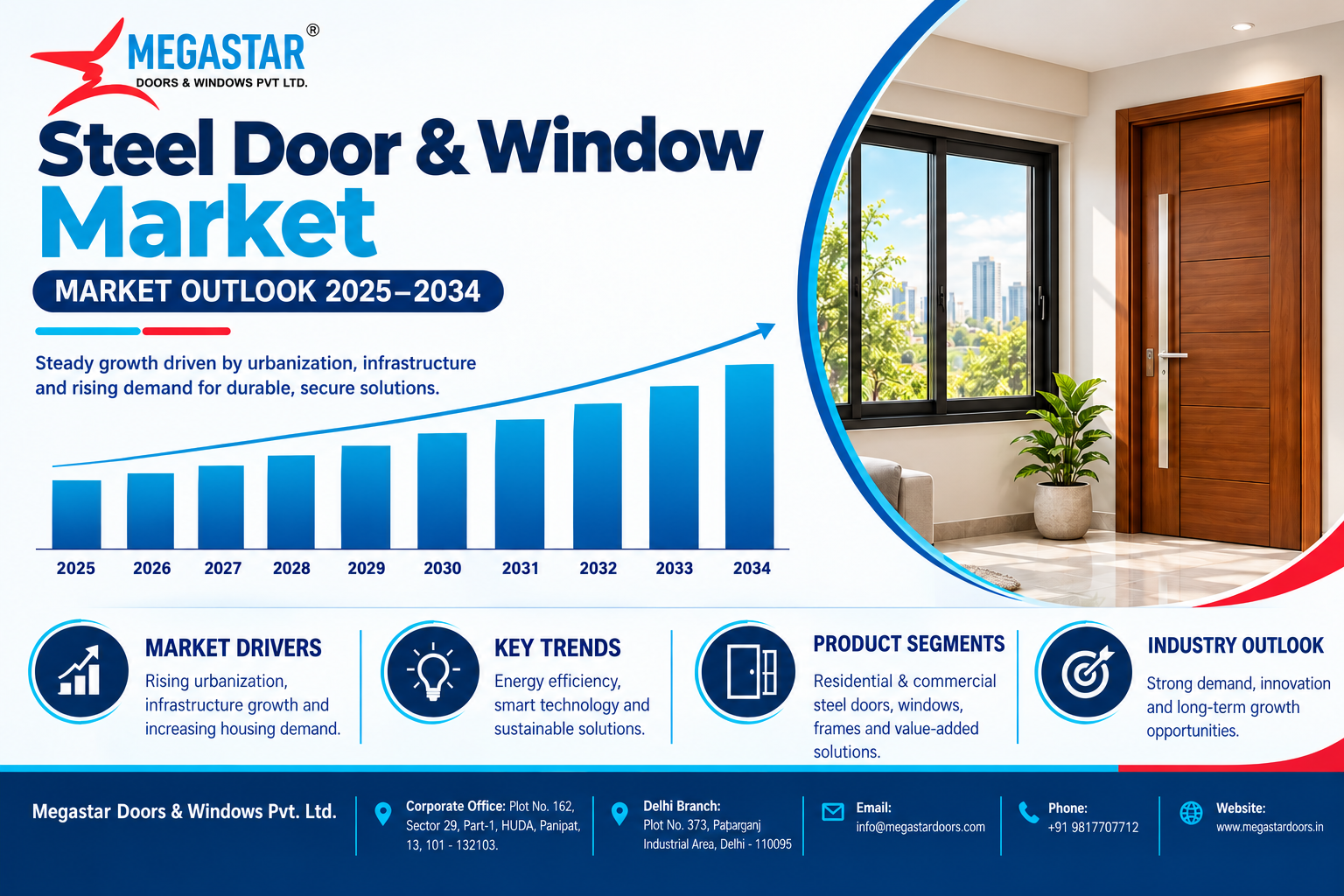
India’s door and window demand is rising at a moderate, stable pace, and metal doors are a rising share of it. IMARC Group reports that the India window and door market grew from USD 6.8 billion in 2025 to USD 7.0 billion in 2026. It expects USD 9.4 billion by 2034, a CAGR of 3.77% over 2026–2034. Applying that CAGR gives roughly USD 7.3 billion for 2027 (our calculation, not an IMARC figure).
Research and Markets values the India doors market at USD 3.90 billion in 2024. It projects USD 5.94 billion by 2034 at a 4.30% CAGR.
| Indicator |
Figure |
Source |
| India window and door market, 2025 |
USD 6.8 billion |
IMARC Group |
| India window and door market, 2026 |
USD 7.0 billion |
IMARC Group |
| Forecast, 2034 |
USD 9.4 billion |
IMARC Group |
| CAGR, 2026–2034 |
3.77% |
IMARC Group |
| India doors market, 2024 |
USD 3.90 billion |
Research and Markets |
| India doors market forecast, 2034 |
USD 5.94 billion (CAGR 4.30%) |
Research and Markets |
Research and Markets also notes that metal doors gain share in commercial and institutional projects. Galvanised steel and aluminium doors suit hospitals, data centres and schools because of fire resistance, hygiene rules and endurance.
Organized vs. Unorganized Players
The market is moderately fragmented: national brands and organised manufacturers compete with many local fabricators. Research and Markets describes competition on price, design and material innovation. It adds that firms differentiate on energy efficiency, fire resistance and smart automation.
- Organised players work with engineered designs, documented materials and consistent finishing.
- Unorganised fabricators often win on price, but quality, sheet thickness and coating vary widely.
Established steel door manufacturers such as Megastar, founded in 2011 in Panipat, compete on documented specifications and repeatable quality rather than price alone.
Regional Demand Hotspots (Delhi NCR, Maharashtra, Gujarat, Tamil Nadu, Karnataka)
North India leads door demand, with Delhi NCR, Haryana and Punjab at the centre. Research and Markets reports strong construction in Delhi NCR, Haryana and Punjab. It points to housing, retail malls and metro growth in Gurugram and Noida.
- Delhi NCR and Haryana: housing, malls, metro and warehousing. Panipat’s location gives Megastar direct access to this belt.
- Maharashtra: high-rise residential and mixed-use projects. IMARC cites a 1.8 million sq ft Oberoi Realty development in Worli, Mumbai.
- Gujarat: industrial and manufacturing growth. Encore-Alcom opened a large door and window plant in Surat in January 2025.
- Karnataka (Bengaluru) and Tamil Nadu: IT corridors, smart housing and commercial construction. Research and Markets names Bengaluru and Hyderabad as demand drivers in the South.
Key Factors Driving Steel Door Demand in India
Five forces drive demand: urban housing, government programmes, fire and security rules, industrial construction and low-maintenance preferences.
- Urbanization and Housing Demand - Urban housing growth directly increases demand for secure, durable entrance and utility doors. IMARC links market growth to residential and commercial construction. Research and Markets expects the real estate sector to reach USD 1 trillion by 2030, citing NITI Aayog and MoHUA estimates. Builders use a steel main door or security steel door for entrances, service areas and staircases.
- Government Infrastructure and Housing Schemes - Housing and city programmes create steady bulk orders for doors. Research and Markets reports that the Government of India sanctioned more than 3.21 crore homes under PMAY in 2024. It also cites the Smart Cities Mission, with an investment of INR 2 lakh crore across 100 cities. Delhi Metro Rail Corporation installed automatic steel doors on newly commissioned underground lines in 2024.
- Fire Safety and Security Regulations - Stricter fire-safety expectations push specifiers toward tested, certified steel doors. In September 2024, Tufwud introduced its FD120 ID, an ISI-marked fully insulated fire door, at Fire & Security India Expo 2024. Research and Markets reports that government buildings and gated communities increasingly specify BIS-compliant exterior doors.
- Growth of Warehousing, Industrial and Data Center Construction - Industrial and data-centre projects need doors that resist impact, fire and tampering. Research and Markets reports that BFSI, warehousing and defence users now ask for metal doors that meet noise-control and intruder-prevention needs. It also cites industrial corridor projects, such as Sagarmala and Bharatmala, as new demand sources for mid-range and industrial-grade doors.
- Preference for Low-Maintenance, Termite-Proof Doors - Steel does not rot, warp or attract termites, which lowers lifetime upkeep. Research and Markets notes that metal doors offer lifecycle cost benefits over wood or plastic in coastal and industrial areas exposed to humidity, pests and chemicals. Routine care is limited to touch-up paint and hinge lubrication.
Residential vs. Commercial vs. Industrial Demand
Each segment buys steel doors for a different reason: security at home, compliance in commercial buildings, durability in industry.
- Residential (apartments, villas, builder floors) - Residential buyers mainly want a strong, good-looking entrance door. Common choices include the steel main door, security steel door and wood-finish steel doors. Developers prefer factory-finished, ready-to-install units, which cut on-site labour and speed up handover.
- Commercial (offices, malls, hotels, hospitals) - Commercial projects need fire-rated, hygienic and high-traffic doors. Offices and malls use fire exits and service doors. Hospitals favour smooth, easy-to-clean surfaces. Hotels and co-working spaces order in volume and expect uniform finishes.
- Industrial and Institutional (factories, schools, government buildings) - Industrial and institutional users order the largest quantities and value strength and compliance most. Factories need impact-resistant doors. Schools and government buildings often specify BIS-compliant products in tenders. Research and Markets notes that swinging doors dominate here for their simplicity, cost-efficiency and compatibility with fire-rated and solid-core builds.
Types of Steel Doors Gaining Popularity
Six types lead current demand: security, fire-rated, galvanised and powder-coated, stainless steel, designer, and modular doors.
- Security Steel Doors - A security steel door uses thicker sheet, a reinforced frame and multi-point locking to resist forced entry. Typical features are a pressed-steel leaf, a rigid frame, anti-theft locks and a rust-resistant coating. Residential entrances, shops, BFSI premises and storerooms use them.
- Fire-Rated Steel Doors - A fire-rated steel door is tested to hold back flame and heat for a set period. India’s fire-check door test method sits in IS 3614. A door that merely looks like steel is not a tested fire door. Always ask for the test report.
- Galvanized and Powder-Coated Steel Doors - Galvanised sheet carries a zinc layer, and powder coating adds a tough painted finish on top. Together they slow rust in humid and coastal conditions. Research and Markets notes that composite and steel exterior doors with powder-coated finishes suit India’s harsh climate.
- Stainless Steel Doors - Stainless steel doors resist corrosion and clean easily, so they suit hygiene-critical or high-moisture areas. They cost more than painted mild steel. Specify the stainless grade and finish when you request a quote.
- Designer and Wood-Finish Steel Doors - Designer steel doors combine steel strength with laminate, veneer-look or embossed finishes. Buyers who want a wooden look without termite or warping risk choose them. Customisation of finishes continues to grow in the Indian market.
- Pre-Fabricated and Modular Steel Doors - Pre-fabricated steel doors arrive factory-finished, with frames and hardware matched. Research and Markets reports that suppliers increasingly offer turnkey packages of frames, hardware and finishes. This simplifies procurement for developers and EPC companies.
Emerging Steel Door Trends in India in 2027
Smart access, finish customisation, sustainability and direct supply define the next phase of the market.
- Smart Locks and Digital Access - Steel doors increasingly accept digital locks, RFID, biometric and app-based access. Research and Markets reports growing adoption of doors with motion sensors, facial recognition and mobile app support in high-rises and gated communities. ABB India launched wireless smart door controls in September 2024.
- Designer Finishes and Customization - Buyers now expect made-to-order sizes, colours and textures. Research and Markets notes that rising customisation demand pushes firms to supply made-to-order products in urban and semi-urban areas.
- Eco-Friendly and Recyclable Materials - Steel is fully recyclable, which supports green-building goals. IMARC lists sustainability as a market driver. Choose suppliers who can document material sourcing and coating processes.
- Online Ordering and Direct-to-Builder Supply - Manufacturers increasingly sell through digital channels and direct partnerships with developers. Research and Markets reports that players use e-commerce sites and strategic partnerships with real estate developers and interior consultants. Buyers can now request specifications and quotes online.
Steel Doors vs. Wood, Aluminium and UPVC
Steel wins on strength, fire and termite resistance. Wood wins on tradition, aluminium and uPVC on weight and design. The table summarises the trade-offs.
| Factor |
Steel |
Wood |
Aluminium |
uPVC |
| Forced-entry resistance |
Very high |
Moderate |
Moderate |
Low to moderate |
| Fire resistance |
High (rated versions tested) |
Low |
Moderate |
Low |
| Termite resistance |
Immune |
Vulnerable |
Immune |
Immune |
| Moisture and rust |
Needs coating |
Swells and warps |
Corrosion-resistant |
Moisture-resistant |
| Maintenance |
Low |
High |
Low |
Low |
| Design flexibility |
Good with finishes |
Excellent |
Good |
Moderate |
- Durability and Maintenance - Steel lasts longest under heavy use when its coating stays intact. Touch up chips promptly and lubricate hinges. Wood needs repolishing, and uPVC can discolour under strong sun.
- Fire and Termite Resistance - Steel cannot be eaten by termites and does not feed a fire. Wood fails on both counts unless treated. Use IS 3614-tested doors where a fire rating is required.
- Cost and Lifespan - Steel costs more than basic flush doors at purchase but less over its life. Wooden doors need periodic repair or replacement. Steel doors with intact coatings serve for many years with minimal upkeep.
- Look and Design Flexibility - Wood offers the widest natural look. Steel now matches it through wood-finish laminates and powder-coat effects. Aluminium and uPVC suit sliding and glazed formats. Research and Markets notes that wooden doors dominate the material mix, while metal gains share in security-driven segments.
Steel Door Price in India (2027)
Indicative steel door prices in India run from roughly ₹300 per sq ft for basic fabricated doors to ₹1,500 per sq ft or more for tested fire-rated and branded security doors. Every figure below is indicative and subject to grade, thickness, quantity, location and market rates. None is a fixed quote.
Price Range by Door Type
| Product form |
Indicative price (₹) |
Unit |
What moves the price |
| Basic pressed-steel entrance door |
4,500–8,000 |
per door (about 7 ft height) |
Gauge, size, lock |
| Security steel door, multi-point lock |
8,000–25,000 |
per door |
Sheet thickness, lock, finish |
| Galvanised / powder-coated steel door |
300–900 |
per sq ft |
Coating, size, volume |
| Fire-rated steel door (tested) |
400–1,500 |
per sq ft |
Rating, core, test report |
| Stainless steel door |
900–2,500 |
per sq ft |
SS grade, finish |
| Designer / wood-finish steel door |
700–2,000 |
per sq ft |
Laminate, design |
| Steel sheet (CR / GI), raw material |
55–85 |
per kg |
Grade, thickness, market |
Public marketplace listings support these ranges, with wide variation. One listing shows an entrance steel door from ₹4,500 per piece, and another shows a security door at ₹5,500 per piece. Fire-rated steel doors appear from about ₹3,900 per square metre, or roughly ₹360 per sq ft. Other listings run much higher for premium or certified products. One 2026 guide places branded steel security doors at ₹3,000–₹4,200 per sq ft installed. Treat any very low price with caution, as it may signal thin sheet or weak coating.
What Affects the Cost (gauge, coating, lock, brand, fire rating)
Gauge, coating, lock, brand and fire rating together decide most of the price.
- Gauge and thickness: thicker sheet adds strength and cost.
- Coating: galvanising plus powder coating costs more than plain paint, but lasts longer.
- Lock and hardware: multi-point and digital locks add significantly.
- Brand: established makers charge for consistency and documentation.
- Fire rating: tested and certified doors cost more than uncertified ones.
- Size and customisation: non-standard sizes and finishes raise the rate.
- Taxes and installation: confirm whether GST and fitting are included.
Bulk and Project Pricing
Bulk orders lower the per-unit rate, because tooling, sheet purchase and finishing are shared across the batch. Provide quantity, sizes, delivery schedule and specification for a project quote. Megastar prices bulk and project orders on enquiry.
Top Steel Door Manufacturers and Brands in India
India has national brands, regional makers and specialist manufacturers. Compare them on documentation, range and service, not name alone.
Leading National Brands
- Tata Steel AASHIYANA (Tata Pravesh): Tata Steel’s door brand, known to builders and homebuyers across India.
- Kamdhenu: a recognised Indian building-materials brand. Request its current door range and specifications directly.
- JSW Steel: One of India’s leading steel makers, shaping growth through high-quality steel and solutions that support infrastructure and everyday progress.
- Megastar Doors & Windows Pvt. Ltd.: a premium steel and aluminium door and window manufacturer in Panipat, Haryana, operating since 2011. Megastar builds each product with advanced technology, high-grade materials and expert craftsmanship, and it offers steel doors for residential, commercial and institutional use.
Regional and Emerging Manufacturers
Regional manufacturers often offer faster delivery and local customisation. Many are strong in a single state or product type. Confirm their quality documentation as you would for a national brand.
How to Evaluate a Manufacturer
Judge a manufacturer by evidence: material documents, specifications, samples, references and a transparent quote.
- Ask for sheet thickness and coating details in writing.
- Request material test documentation and fire-test reports where relevant.
- Inspect a sample for weld quality, finish and alignment.
- Compare lock, hinge and hardware specifications.
- Confirm lead time, packing, delivery and after-sales support.
- Check how clear and detailed the quote is.
Challenges Facing the Steel Door Industry
Steel door makers face price swings, material competition, uneven quality and logistics limits.
- Steel Price Volatility - Raw steel prices move with the market, which affects quotes and margins. Manufacturers hedge by quoting validity periods and buying in planned lots. Buyers should ask how long a quote stays valid.
- Competition from Alternative Materials - Engineered wood, uPVC and WPC doors compete on price and look. Research and Markets reports a shift toward these materials due to timber cost and deforestation concerns. Steel counters with security, fire and termite performance.
- Quality Inconsistency and Unorganized Sector Pricing - Low-priced doors often use thin sheet or weak coating. The cheapest quote can cost more over time through rust or damage. Compare specifications, not only price.
- Logistics and Installation Constraints - Steel doors are heavy, and incorrect installation harms performance. Plan transport, lifting and frame fixing in advance. Ready-to-install units with matched frames reduce site errors.
Buying Guide: How to Choose the Right Steel Door
Choose a steel door by checking gauge, certifications, coating, locking and supplier documentation in that order.
- Check Steel Gauge and Thickness - Thicker sheet gives more strength, but weight and cost also rise. Typical pressed-steel doors use roughly 0.8–1.6 mm sheet, with heavier frames. Ask for the actual thickness, not just a gauge number.
- Verify Certifications (BIS standards, ISO, fire-test reports) - Request documents, and do not accept claims without them. Relevant Indian references include IS 1038 (steel doors, windows and ventilators), IS 4351 (steel door frames) and IS 3614 (fire-check doors). Ask suppliers which standards their products meet and for the test reports.
- Compare Coating, Locking and Warranty - Coating decides rust life, and locking decides security. Compare zinc coating, powder-coat thickness, lock type and hinge quality. Get warranty terms in writing.
Checklist for Bulk and Project Buyers
- Door sizes, quantities and delivery phases
- Sheet gauge, frame section and leaf thickness
- Coating system and colour
- Lock, hinge and closer specifications
- Fire rating and test report, if required
- Sample approval before full production
- Packing, transport and installation scope
- Price validity, taxes and payment terms
Sample specification table. This is a sample only. Confirm every value against the final drawing and material test certificate before ordering.
| Door type |
Reference standard |
Sheet thickness (typical) |
Leaf thickness |
Frame |
Finish |
Supply condition |
| Security steel door |
IS 1038, IS 4351 |
0.8–1.6 mm |
40–50 mm |
Pressed steel, 1.2–2.0 mm |
Powder coat |
Factory-finished, frame fitted |
| Fire-rated steel door |
IS 3614 |
1.0–1.6 mm |
45–54 mm |
Pressed steel |
Powder coat |
Tested configuration, with report |
| Galvanised door |
IS 277 (GI sheet), IS 4351 |
0.8–1.2 mm |
35–46 mm |
GI frame |
Zinc plus paint |
Primed or coated |
| Stainless steel door |
Grade as specified |
As specified |
As specified |
SS frame |
Brushed or satin |
Made to order |
Opportunities and Future Outlook
Housing, infrastructure, warehousing and exports give manufacturers and distributors clear growth routes.
- Opportunities for Manufacturers and Distributors - Growth lies in fire-rated, security and modular doors, plus project supply to builders and EPC firms. Research and Markets notes that tier 2 and tier 3 cities are under-penetrated and that smart city projects create new demand. Steel door dealers and steel door suppliers can add value through stock, installation support and fast delivery.
- Export Potential - Export prospects are expanding. Research and Markets reports that Indian door manufacturers are increasingly supplying to the Middle East and Africa. Steel door exporters should prepare specification sheets, test documentation and export packing.
- What to Expect Beyond 2027 - Expect steady growth, more tested fire and security doors, and wider smart-lock use. IMARC projects the broader market to reach USD 9.4 billion by 2034. Buyers will ask for more documentation, and organised steel door manufacturers in India stand to gain share.
Frequently Asked Questions
What is the outlook for the Indian steel door market in 2027?
The outlook is steady growth. IMARC projects the India window and door market to rise from USD 7.0 billion in 2026 to USD 9.4 billion by 2034, a 3.77% CAGR. Housing, infrastructure, fire safety and security needs support metal door demand within this growth.
Is demand for steel doors increasing in India?
Yes. Research and Markets reports that metal doors are gaining share in commercial, institutional and high-security uses. Urban housing, government schemes, warehousing and fire-safety rules drive this. Steel doors also appeal to buyers who want termite-proof, low-maintenance entrances.
What factors are driving steel door demand in India?
Key drivers include urban housing growth, schemes such as PMAY and the Smart Cities Mission, stricter fire and security expectations, warehouse and data-centre construction, and a preference for termite-proof, low-maintenance doors. Rising awareness of home security also pushes demand for steel main doors.
Which types of steel doors are used in commercial buildings?
Commercial buildings mainly use fire-rated steel doors, security steel doors, galvanised and powder-coated doors, and stainless steel doors. Hospitals, offices, malls and hotels choose by fire rating, hygiene, traffic load and finish. Modular, factory-finished doors help large projects move faster.
How much does a steel door cost in India?
Indicative prices run from about ₹4,500 per door for basic entrance doors to ₹1,500 per sq ft or more for tested fire-rated and branded security doors. Gauge, coating, lock, fire rating, size and quantity decide the final rate. These are not fixed quotes.
Are steel doors better than wooden doors for security?
Generally, yes. Steel resists forced entry better than wood, especially with thicker sheet, reinforced frames and multi-point locks. Steel also resists termites and fire. Wood offers a more natural look, but steel doors with wood-finish laminates can match it without the security trade-off.
What is the difference between a steel security door and a fire-rated door?
A steel security door resists forced entry using thick sheet and strong locks. A fire-rated door is tested, under standards such as IS 3614, to resist flame and heat for a set time. Some doors combine both, but confirm each with test documentation.
Which industries use steel doors the most?
Construction and real estate lead, followed by healthcare, education, hospitality, warehousing, data centres, government and BFSI. Research and Markets highlights hospitals, data centres and schools for fire resistance and hygiene, and BFSI and warehousing for security and noise control.
What should buyers check before buying steel doors in bulk?
Check sheet thickness, coating, frame and lock specifications, relevant IS standards, fire-test reports, sample quality, lead time, delivery terms and quote validity. Approve a sample before full production. Compare written specifications from several steel door suppliers, not price alone.
What opportunities exist for steel door manufacturers and distributors in India?
Opportunities include fire-rated and security doors, modular and ready-to-install supply, project orders from builders and EPC firms, tier 2 and tier 3 city expansion, and exports to regions such as the Middle East and Africa. Dealers can add stock, installation and service.
Conclusion
Four takeaways stand out.
- Demand is steady and growing. IMARC projects the India window and door market at USD 9.4 billion by 2034, and metal doors keep gaining share in security-led, commercial and institutional projects.
- Specifications decide quality. Sheet gauge, coating, locking and IS references matter more than brand claims or the lowest price.
- Prices vary widely. Indicative rates run from about ₹300 per sq ft for basic fabricated doors to ₹1,500 per sq ft or more for tested fire-rated units. Always confirm in writing.
- Supplier evidence builds trust. Ask for material documents, test reports and samples before ordering in bulk.
Megastar Doors & Windows Pvt. Ltd. has manufactured premium steel and aluminium doors and windows in Panipat, Haryana, since 2011. We combine advanced technology, high-grade materials and expert craftsmanship in every product. Whether you need a security steel door, a steel main door, or bulk steel doors for a project, our team will help you match the specification to your application.
Request a quote or call us for a consultation. Send your door sizes, quantities, finish and application, and Megastar will share a transparent, specification-based quotation.